
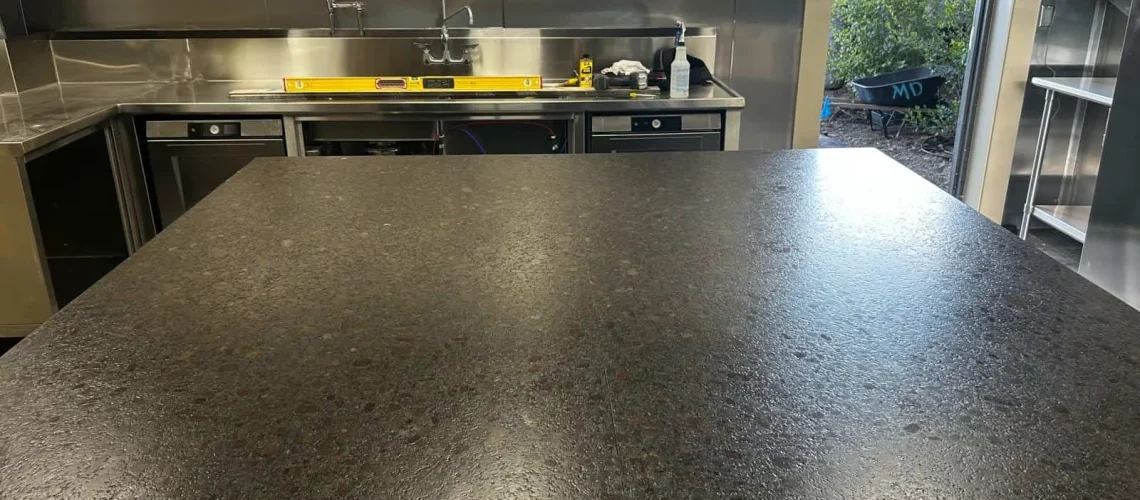

A beautiful slab can lose some of its impact if the seam lands in the wrong place. Seams are sometimes necessary when a kitchen has long runs, large islands, tight access, or stone that cannot safely be transported in one piece. The goal is not always to eliminate every seam. It is to place each one where it looks natural, stays strong, and works with the pattern of the stone.
Some Kitchens Simply Cannot Be Made From One Piece
Stone slabs have size limits. Doorways, hallways, stairs, cabinet layouts, and the weight of the material can also affect what can be carried safely into a home.
Long countertops may therefore need to be divided into two or more sections. That is not automatically a sign of poor work. A carefully planned seam can be subtle and dependable.
Before fabrication, we look at the entire layout rather than choosing a seam location only because it is convenient to cut.
The Strongest Location Is Not Always the Most Obvious One
A seam should avoid creating unnecessary weakness around already vulnerable areas. Sink and cooktop openings remove material from the slab, leaving narrower sections that need careful handling.
The best seam placement for granite and quartz takes several things into account:
- Cabinet support below the joint
- Distance from large cutouts
- Stone pattern and vein direction
- How visible the area will be in daily use
A seam near a busy preparation area may also receive more spills and wear than one placed in a quieter section of the kitchen.
For homeowners considering Idaho Falls ID Countertops, this is an important detail to discuss before the slab is cut. Once fabrication begins, changing the seam plan may no longer be simple.
Veining Can Either Hide a Seam or Draw Attention to It
Patterned stone adds another challenge. A strong vein that suddenly changes direction at a joint can make even a tight seam stand out.
During layout, we study how the pattern moves from one section to another. Sometimes shifting a cut by only a few inches creates a much cleaner transition.
With heavily veined materials, the goal is not to make the joint disappear completely. Instead, the two pieces should feel visually connected.
This is one reason slab layout matters as much as installation skill.
A Good Seam Depends on What Is Underneath It
Even a beautiful joint needs solid support. Cabinets must be level and stable so both stone pieces meet correctly. If one side settles or moves, the seam may become more noticeable over time.
At Custom Royal Countertops & Tile, we also pay close attention to fit, adhesive color, edge alignment, and surface height. Quality countertops should feel smooth across the joint and look intentional from normal viewing angles.
The best seam is often the one guests never think about.
Conclusion
Seams are sometimes unavoidable, but poor seam placement is not. Strength, cabinet support, cutouts, slab pattern, and visibility should all be considered before fabrication begins. For stonework planned with care from slab layout through final installation, call Custom Royal Countertops & Tile at (208) 313-8385 today.