
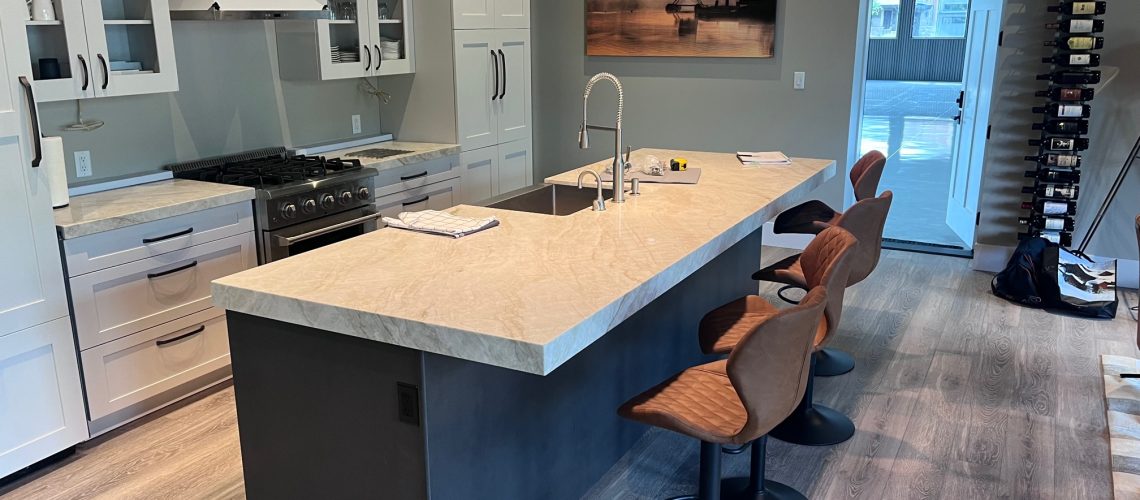

A stone slab is strongest when it is whole. The moment a large opening is cut for a sink or cooktop, the shape changes. Narrow strips of material remain around the opening, and those areas may carry more stress during lifting, installation, and daily use. That does not mean cutouts are unsafe. It means they need to be planned and fabricated with care.
Cutouts Remove Some of the Slab’s Strength
A large sink or cooktop opening can leave only a few inches of stone along the front or back edge. Those narrow sections are easier to flex or crack than a full slab.
This is especially important with large undermount sinks, farmhouse sinks, and wide cooktops.
When we fabricate countertops, we look at more than the appliance size. We also consider:
- How much stone remains around the opening
- Where seams will be placed
- Whether extra support is needed
- How the slab will be moved into the home
The goal is to protect the stone before it ever reaches the cabinets.
Inside Corners Need Careful Shaping
Sharp inside corners can create concentrated stress. That is why sink and cooktop cutouts are usually shaped with smooth, rounded corners instead of hard 90-degree cuts.
Understanding why stone countertops crack around sink cutouts often comes down to stress distribution. A rounded corner gives force a smoother path through the material. A sharp corner can act like a starting point for a crack.
The exact shape depends on the sink, cooktop, stone type, and fabrication method.
Support Under the Stone Matters After Installation
Even a perfectly cut slab can have problems if the cabinets below do not support it properly.
A heavy sink, for example, should not depend only on adhesive holding it to the stone. The cabinet and sink support system should help carry that weight.
For homeowners choosing Rexburg ID countertops, it is worth asking how the sink and surrounding stone will be supported before installation day.
Cooktops also create their own concerns. Heat, appliance weight, and narrow stone sections around the opening all need to be considered as part of one plan.
Cracks Often Show Up Near High-Stress Areas
If a slab ever develops damage, openings are common places to inspect first. The stone may have been stressed during transport, installed over an uneven base, or placed under repeated pressure after installation.
Quality countertops should be measured, cut, carried, and installed with these weak points in mind.
At Custom Royal Countertops & Tile, we plan the cutout before fabrication begins. That includes checking appliance dimensions, seam locations, cabinet support, and the amount of stone left around each opening.
Conclusion
Sink and cooktop cutouts are necessary, but they should never be treated as simple holes in the slab. Their size, shape, support, and location all affect long-term strength. For careful fabrication that protects the most vulnerable parts of your stone, call Custom Royal Countertops & Tile at (208) 313-8385 today.